Monday, February 28, 2011

The 2011 Chicago Auto Show Brings Out The Big Guns


2012 Chevrolet Camaro ZL1

The supercharged V8 will crank out 560 horsepower.


Auto Shows Home Page In Chevrolet parlance, "ZL1" used to mean a street-legal racing all-aluminum big-block V8 engine with 427 cubic inches, 560-ish horsepower and barrels full of whoopass for drag racers and Can Am road racers alike. Chevy has rekindled the "ZL1" fire after 42 years with the new 2012 Camaro ZL1; an uber-Camaro if ever there was one.

The new supercharged, 6.2-liter V8 engine belts out something even headier than 550 hp, while chassis, suspension and braking system reboots make it a track-ready roller coaster ride with license plates. Development is ongoing, so no official performance figures exist yet, but they promise to be shocking.

2012 Dodge Charger SRT8

The new Charger's 6.4-liter Hemi develops 465 horsepower.


Auto Shows Home Page Launching later this year -- and launching hard with 465 hp -- Dodge’s Charger SRT8 unfurled its flag for the first time at the Chicago Auto Show.

Powered by a 6.4-liter Hemi, preliminary power figures of 465 hp and 465 ft-lbs of torque promise acceleration in the low four-second range. The SRT8 is also the first Dodge with paddle shifters for the five-speed automatic, and two-mode adaptive shock absorbers promise sharper handling or a softer ride quality.

The musclebound V8 can also operate in four-cylinder mode, which helps with fuel economy. Huge racing-derived Brembo brakes stop the SRT8 from charging. An Autobahn-league 175-mph estimated top speed turns state borders from hours to minutes away. New front and rear bodywork adorn the SRT8 with a new funky LED taillamp design.

The touchscreen dash display can now show information on steering input, power output and even calculate zero-to-60 mph times, braking distances, lateral g-forces under hard cornering, plus eighth-mile and quarter-mile elapsed times. These so-called "Performance Pages" are sure to warm up your date for the evening.

Shelby GT350 Convertible

The Mustang-based GT350 offers three engine variations (and up to 624 hp).


Auto Shows Home Page While Dodge and Chevy were slugging out the musclecar wars with the Camaro ZL1 and the Charger SRT8, the Ford camp was not exactly silent, thanks to Shelby.

Shelby American announced the first convertible option for the GT350 since 1970. Two new colors of the limited-production car will be Race Red and Kona Blue. The Mustang-based GT350 is offered in a 430-hp version, a 525-hp supercharged version or a 624-hp supercharged version.


Acura TL

The TL's 3.7-liter V6 makes more than 300 hp.


Auto Shows Home Page
Acura debuted the facelifted 2012 TL sedan, calling it "innovation refined." As a facelift, you'd hardly know it. Front and rear fascia have been rounded, smoothed and sanded, but the now-familiar pointy Acura beak is still front and center. Taillights are brighter, but not repositioned.

The automatic transmission adds a gear, now totaling six speeds, and can also downshift two gears at a time when prodded. The standard 3.5-liter, 280-hp V6 engine / front-wheel drive combo improves economy, up from 26 to 29 mpg highway. All-wheel drive is still offered on the 3.7-liter, 305-hp SH model. The TL's navigation now boasts 60 gigabytes' worth of space and a full VGA


Volkswagen Jetta GLI

VW's turbocharged 2.0-liter engine packs a punch.


Auto Shows Home Page Volkswagen's Jetta GLI sports sedan will be powered by their lauded 200-hp, 2.0-liter turbocharged four-cylinder engine. Rowing through a six-speed manual transmission returns 31 mpg highway, or selecting a DSG twin-clutch automatic returns 32 highway mpg. Also, a more sophisticated independent rear suspension replaces the standard Jetta's simple twist-beam axle, netting far more precise control over bumpy corners and a more sporting ride.

The GLI will start at just $24,265 (all prices include $770 destination charge. An Autobahn edition adds 18-inch alloy wheels, a sunroof, dual-zone climate control and an impressive Fender Premium Audio System for $26,315. Add Navigation, push-button start and keyless entry (all packaged together) and you're still only at $27,215. Truly a funhouse bargain.


Hyundai Veloster Rally Racer

A real racing version of Hyundai's two-door.

Auto Shows Home Page Having debuted at the Detroit Auto Show, the 2012 Hyundai Veloster will soon be taken down a different road, or more aptly, a lack of road. Hyundai announced in Chicago that a rally racing version of the little two-door will campaign the 2011 U.S.

Rallycross Championship with race car driver Rhys Millen. Millen will fabricate the first 500-hp all-wheel-drive rally Veloster. A second car will be piloted by Marcus Dodd and freestyle motorbike rider Robbie Maddison. Millen and Maddison will also drive the rally cars at the Summer X Games.


Hyundai Genesis R-Spec 5.0

Korea flexes some muscle with a 429-hp V8.


Auto Shows Home Page
Using the remarkably-good Genesis luxury sedan as a basis, Hyundai introduced the 2012 Genesis R-Spec 5.0 with the most powerful Hyundai engine yet, a 5.0-liter V8 that develops 429 hp through direct fuel injection.

This is Hyundai's first direct-injection engine and despite the additional 44 hp over the standard V8, suffers only 1 mpg in city and highway fuel economy. The new 5.0-liter V8 is coupled to a new Hyundai-developed, eight-speed automatic transmission. Suspension, wheels and brakes are beefed up to match the added performance capabilities of the new engine.


Audi A7 Sportback

Audi's sleek answer to the BMW 5-series GT.


Auto Shows Home Page
Audi's A7 Sportback -- an answer to the BMW 5-Series Gran Turismo -- made its appearance in Chicago and is a far more pleasing visage the the decidedly awkwardly proportioned Bimmer.

Sized between the large A8 sedan and the mid-sized A6, the A7 Sportback (chic marketing-speak for a hatchback) is powered by a 300-hp, 3.0-liter supercharged V6. Backing up the V6 is an eight-speed automatic transmission and the latest Quattro all-wheel-drive system.


Lexus CT200h Concept by Five Axis

The exception that proves the rule: even green cars hulk up.


Auto Shows Home Page The upcoming Lexus CT 200h entry-luxury hybrid, based on the Prius, has been modified by tuning partner Five Axis with large wheels, flared fenders, and an adjustable aftermarket suspension.


It was also darkened with black pearlescent paint. The production CT200h will achieve 42 mpg in combined city/highway use and goes on sale in March.


Share/Bookmark

West Moves To Help Libya Uprising, Gadhafi Digs In


TRIPOLI, Libya – The U.S. military deployed naval and air units near Libya, and the West moved to send its first concrete aid to Libya's rebellion in the east of the country, hoping to give it the momentum to oust Moammar Gadhafi. But the Libyan leader's regime clamped down in its stronghold in the capital and appeared to be maneuvering to strike opposition-held cities.

In Washington, Defense Department spokesman Col. Dave Lapan said the naval and air forces were deployed to have flexibility as Pentagon planners worked on contingency plans, but did not elaborate. The U.S. has a regular military presence in the Mediterranean Sea.

US ready to help Libya's insurgentsThe European Union slapped an arms embargo, visa ban and other sanctions on Libyan leader Moammar Gadhafi's regime, as British Prime Minister David Cameron told British lawmakers Monday he is working with allies on a plan to establish a military no-fly zone over Libya, since "we do not in any way rule out the use of military assets" to deal with Gadhafi's embattled regime.
In the most direct U.S. demand for Gadhafi to step down, Secretary of State Hillary Rodham Clinton said the Libyan leader must leave power "now, without further violence or delay."

France was sending two planes with humanitarian aid, including medicine and doctors, to Benghazi, the opposition stronghold in eastern Libya, French Prime Minister Francois Fillon said. That would be the first direct Western aid to the uprising that has taken control of the entire eastern half of Libya. Fillon said it was the start of a "massive operation of humanitarian support" for the east and that Paris was studying "all solutions" — including military options.


The two sides in Libya's crisis appeared entrenched in their positions, and the direction the uprising takes next could depend on which can hold out longest. Gadhafi is dug in in Tripoli and nearby cities, backed by security forces and militiamen who are generally better armed than the military. His opponents, holding the east and much of the country's oil infrastructure, also have pockets in western Libya near Tripoli. They are backed by mutinous army units, but those forces appear to have limited supplies of ammunition and weapons.

In the two opposition-held cities closest to Tripoli — Zawiya and Misrata — rebel forces were locked in standoffs with Gadhafi loyalists.

An Associated Press reporter saw a large pro-Gadhafi force massed on the western edge of Zawiya, some 30 miles (50 kilometers) west of Tripoli, with about a dozen armored vehicles and tanks and jeeps mounted with anti-aircraft guns. An officer said they were from the elite Khamis Brigade, named after the Gadhafi son who commands it. U.S. diplomats have said the brigade is the best equipped force in Libya.


Residents inside the city said they were anticipating a possible attack.

"Our people are waiting for them to come and, God willing, we will defeat them," one resident who only wanted to be quoted by his first name, Alaa, told AP in Cairo by telephone.

In Misrata, Libya's third largest city 125 miles (200 kilometers) east of Tripoli, Gadhafi troops who control part of an air base on the city's outskirts tried to advance Monday. But they were repelled by opposition forces, who include residents armed with automatic weapons and army unites allied with them, one of the opposition fighters said.

He said there were no casualties reported in the clashes and claimed that his side had captured eight soldiers, including a senior officer.

The opposition controls most of the air base, and the fighter said dozens of anti-Gadhafi gunmen have arrived from further east in recent days as reinforcements.

Kadhafi, Mubarak slapped with travel bans

Several residents of the eastern city of Ajdabiya said Gadhafi's air force also bombed an ammunition depot nearby held by the opposition. One, 17-year-old Abdel-Bari Zwei, reported intermittent explosions and a fire, and another, Faraj al-Maghrabi, said the facility was partially damaged. The site contains bombs, missiles and ammunition — key for the undersupplied opposition military forces.

State TV carried a statement by Libya's Defense Ministry denying any attempt to bomb the depot.
Ajdabiya lies about 450 miles (750 kilometers) east of Tripoli along the Mediterranean coast.
Gadhafi opponents have moved to consolidate their hold in the east, centered on Benghazi — Libya's second largest city, where the uprising began. Politicians there on Sunday set up their first leadership council to manage day-to-day affairs, taking a step toward forming what could be an alternative to Gadhafi's regime.

The opposition is backed by numerous units of the military in the east that joined the uprising, and they hold several bases and Benghazi's airport. But so far, the units do not appear to have melded into a unified fighting force. Gadhafi long kept the military weak, fearing a challenge to his rule, so many units are plagued by shortages of supplies and ammunition.

Gadhafi supporters said Monday that they were in control of the city of Sabratha, west of Tripoli, which has seemed to go back and forth between the two camps the past week. Several residents told The Associated Press that protesters set fire to a police station, but then were dispersed. Anti-Gadhafi graffiti — "Down with the enemy of freedom" and "Libya is free, Gadhafi must leave" — were scrawled on some walls, but residents were painting them over.

In the capital, several hundred protesters started a march in the eastern district of Tajoura, which has been the scene of frequent clashes. After the burial of a person killed in gunfire last week, mourners began to march down a main street, chanting against the Libyan leader and waving the flag of Libya's pre-Gadhafi monarchy, which has become a symbol of the uprising, a witness said.

But they quickly dispersed once a brigade of pro-Gadhafi fighters rushed to the scene, scattering before the gunmen could fire a shot, the witness said. He and other residents in the capital spoke on condition of anonymity for fear of retaliation.


Kadhafi, Mubarak slapped with travel bans

There were attempts to restore aspects of normalcy in the capital, residents said. Many stores downtown reopened, and traffic in the streets increased.
Tripoli was in turmoil on Friday, when residents said gunmen opened fire indiscriminately on protesters holding new marches. But since then, the capital has been quiet — especially since foreign journalists invited by Gadhafi's regime to view the situation arrived Friday.

Long lines formed outside banks in the capital by Libyans wanting to receive the equivalent of $400 per family that Gadhafi pledged in a bid to shore up public loyalty.
One resident said pro-Gadhafi security forces man checkpoints around the city of 2 million and prowl the city for any sign of unrest. She told The Associated Press that the price of rice, a main staple, has gone up 500 percent amid the crisis, reaching the equivalent of $40 for a five-kilogram (10-pound) bag.

Bakeries are limited to selling five loaves of bread per family, and most butcher shops are closed, she said.
Some schools reopened, but only for a half day and attendance was low. "My kids are too afraid to leave home and they even sleep next to me at night," said Sidiq al-Damjah, 41 and father of three. "I feel like I'm living a nightmare."

Gadhafi has launched by far the bloodiest crackdown in a wave of anti-government uprisings sweeping the Arab world, the most serious challenge to his four decades in power. The United States, Britain and the U.N. Security Council all slapped sanctions on Libya this weekend.
In Geneva, U.S. Secretary of State Hillary Rodham Clinton was meeting Monday with foreign ministers from Britain, France, Germany and Italy, pressing for tough sanctions on the Libyan government. A day earlier, Clinton kept up pressure for Gadhafi to step down and "call off the mercenaries" and other troops that remain loyal to him.

"We've been reaching out to many different Libyans who are attempting to organize in the east and as the revolution moves westward there as well," Clinton said. "I think it's way too soon to tell how this is going to play out, but we're going to be ready and prepared to offer any kind of assistance that anyone wishes to have from the United States."

Two U.S. senators said Washington should recognize and arm a provisional government in rebel-held areas of eastern Libya and impose a no-fly zone over the area — enforced by U.S. warplanes — to stop attacks by the regime. But Fillon said a no-fly zone needed U.N. support "which is far from being obtained today."


Kadhafi, Mubarak slapped with travel bans

Sabratha, 40 miles (65 kilometers) west of Tripoli — a city known for nearby Roman ruins — showed signs of the tug-of-war between the two camps. On Monday, when the journalists invited to Libya by the government visited, many people were lined up at banks to collect their $400. When they saw journalists, they chanted, "God, Moammar and Libya."

Ali Mohammed, a leader from the Alalqa tribe, the main tribe in the area, said in previous days Gadhafi opponents burned the main police station, an Internal Security office and the People's Hall, where the local administration meets. "I then held a meeting with the protesters to stop these acts the people said they will control their children and since then there has been no problems," he said.
"The thugs and rats were roaming the streets and they attacked the police station and then they disappeared," said resident Taher Ali, who was collecting his $400. "They are rats and thugs. We are all with Moammar."

An anti-Gadhafi activist in Sabratha told The Associated Press in Cairo by telephone that the opposition raided the police station and security offices last week for weapons, and had dominated parts of city. But then on Sunday, a large force of pro-Gadhafi troops deployed in the city, "so we withdrew," he said.

"The city is not controlled by us or them. There are still skirmishes going on," he said.
In Tripoli, a government spokesman blamed the West and Islamic militants for the upheaval, saying they had hijacked and escalated what he said began as "genuine" but small protests demanding "legitimate aand much needed political improvements."

"On one hand, Islamists love to see chaos ... this is paradise for them," he said. "The West wants chaos to give them reason to intervene militarily to control the oil."
"The Islamists want Libya to be their Afghanistan ... to complete their crescent of terror," he said. "This is not the first time the Islamic militants and the west find common cause."


Anti-Libyan Leader Moammar Ghadafi gunmen load ...


Share/Bookmark

Last US Veteran of WWI Dies in W. Va. At Age 110


BucklesMORGANTOWN, W.Va. – Frank Buckles enlisted for World War I at 16 after lying about his age. He made it home again and ultimately became that war's last surviving U.S. veteran, campaigning for greater recognition for his comrades-in-arms before dying at 110.
Buckles, who also survived being a civilian POW in the Philippines in World War II, died of natural causes Sunday at his home in Charles Town, biographer and family spokesman David DeJonge said. He was 110.

Buckles had been advocating for a national memorial honoring veterans of the Great War in the nation's capital and asked about its progress weekly, sometimes daily.
"He was sad it's not completed," DeJonge said Monday. "It's a simple straightforward thing to do, to honor Americans."

When asked in February 2008 how it felt to be the last of his kind, he said simply, "I realized that somebody had to be, and it was me." And he told The Associated Press he would have done it all over again, "without a doubt."
On Nov. 11, 2008, the 90th anniversary of the end of the war, Buckles attended a ceremony at the grave of World War I Gen. John Pershing in Arlington National Cemetery.

He was back in Washington a year later to endorse a proposal to rededicate the existing World War I memorial on the National Mall as the official National World War I Memorial. He told a Senate panel it was "an excellent idea." The memorial was originally built to honor District of Columbia's war dead.
Born in Missouri in 1901 and raised in Oklahoma, Buckles visited a string of military recruiters after the United States entered the "war to end all wars" in April 1917. He was repeatedly rejected before convincing an Army captain he was 18. He was actually 16 1/2.

"A boy of (that age), he's not afraid of anything. He wants to get in there," Buckles said.
Details for services and arrangements will be announced later this week, but DeJonge said Buckles' daughter, Susannah Flanagan, is planning for burial in Arlington National Cemetery. In 2008, friends persuaded the federal government to make an exception to its rules and allow his burial there.
Buckles had already been eligible to have his cremated remains housed at the cemetery. To be buried underground, however, he would have had to meet several criteria, including earning one of five medals, such as a Purple Heart.

Buckles never saw combat but joked, "Didn't I make every effort?"

"We have lost a living link to an important era in our nation's history," said Secretary of Veterans Affairs Eric Shinseki. "But we have also lost a man of quiet dignity, who dedicated his final years to ensuring the sacrifices of his fellow 'Doughboys' are appropriately commemorated."

U.S. Sen. Jay Rockefeller called Buckles "a wonderfully plainspoken man and an icon for the World War I generation" and said he will continue fighting for the memorial Buckles wanted.

"He lived a long and rich life as a true American patriot," said U.S. Sen. Joe Manchin, "and I hope that his family's loss is lightened with the knowledge that he was loved and will be missed by so many."
The family asked that donations be made to the National World War One Legacy Project. The project is managed by the nonprofit Survivor Quest and will educate students about Buckles and WWI through a documentary and traveling educational exhibition.

More than 4.7 million people joined the U.S. military from 1917-18. As of spring 2007, only three were still alive, according to a tally by the Department of Veterans Affairs: Buckles, J. Russell Coffey of Ohio and Harry Richard Landis of Florida.

The dwindling roster prompted a flurry of public interest, and Buckles went to Washington in May 2007 to serve as grand marshal of the national Memorial Day parade.
Coffey died Dec. 20, 2007, at age 109, while Landis died Feb. 4, 2008, at 108. Unlike Buckles, those two men were still in basic training in the United States when the war ended and did not make it overseas.

The last known Canadian veteran of the war, John Babcock of Spokane, Wash., died in February 2010.
There are no French or German veterans of the war left alive.
Buckles served in England and France, working mainly as a driver and a warehouse clerk. An eager student of culture and language, he used his off-duty hours to learn German, visit cathedrals, museums and tombs, and bicycle in the French countryside.

After Armistice Day, Buckles helped return prisoners of war to Germany. He returned to the United States in January 1920.
Buckles returned to Oklahoma for a while, then moved to Canada, where he worked a series of jobs before heading for New York City. There, he again took advantage of free museums, worked out at the YMCA, and landed jobs in banking and advertising.

But it was the shipping industry that suited him best, and he worked around the world for the White Star Line Steamship Co. and W.R. Grace & Co.
In 1941, while on business in the Philippines, Buckles was captured by the Japanese. He spent more than three years in prison camps.

"I was never actually looking for adventure," Buckles once said. "It just came to me."
He married in 1946 and moved to his farm in West Virginia's Eastern Panhandle in 1954, where he and wife Audrey raised their daughter. Audrey Buckles died in 1999.

In spring 2007, Buckles told the AP of the trouble he went through to get into the military.
"I went to the state fair up in Wichita, Kansas, and while there, went to the recruiting station for the Marine Corps," he said. "The nice Marine sergeant said I was too young when I gave my age as 18, said I had to be 21."
Buckles returned a week later.

"I went back to the recruiting sergeant, and this time I was 21," he said with a grin. "I passed the inspection ... but he told me I just wasn't heavy enough."
Then he tried the Navy, whose recruiter told Buckles he was flat-footed.
Buckles wouldn't quit. In Oklahoma City, an Army captain demanded a birth certificate.
"I told him birth certificates were not made in Missouri when I was born, that the record was in a family Bible. I said, 'You don't want me to bring the family Bible down, do you?'" Buckles said with a laugh. "He said, 'OK, we'll take you.'"
He enlisted Aug. 14, 1917, serial number 15577.


Share/Bookmark

Big Law's $1,000-Plus an Hour Club


Lawyers who earn more than $1,000 an hour (Thinkstock)

Leading attorneys in the U.S. are asking as much as $1,250 an hour, significantly more than in previous years, taking advantage of big clients' willingness to pay top dollar for certain types of services.

A few pioneers had raised their fees to more than $1,000 an hour about five years ago, at the peak of the economic boom. But after the recession hit, many of the rest of the industry's elite were hesitant, until recently, to charge more than $990 an hour.

While companies have cut legal budgets and continue to push for hourly discounts and capped-fee deals with their law firms, many of them have shown they won't skimp on some kinds of legal advice, especially in high-stakes situations or when they think a star attorney might resolve their problem faster and more efficiently than a lesser-known talent.

Harvey Miller, a bankruptcy partner at New York-based Weil, Gotshal & Manges, said his firm had an "artificial constraint" limiting top partners' hourly fee because "$1,000 an hour is a lot of money." It got rid of the cap after studying filings that showed other lawyers surpassing that barrier by about $50.

Today Mr. Miller and some other lawyers at Weil Gotshal ask as much as $1,045 an hour. "The underlying principle is if you can get it, get it," he said.

"Not many attorneys can command four figures hourly, and I do have trouble swallowing that," said Thomas L. Sager, general counsel at chemical maker DuPont Co. Still, he added, DuPont pays more than $1,000 an hour to a "select few," particularly for mergers-and-acquisitions advice.

Janine Dascenzo, associate general counsel of General Electric Co. (NYSE: GE - News), said that her company is willing to pay what it must when it needs a lawyer with "unique" expertise. "We'll keep paying them a lot of money, because they're worth that," she added.
Industrywide, attorneys in finance-related practices such as M&A, bankruptcy law and taxes, tend to command a premium to their peers in other specialties.

One of the priciest attorneys over the past year, according to court filings, has been Kirk A. Radke, whose specialty at Kirkland & Ellis LLP in New York is advising clients on leveraged buyouts and forming private-equity funds. As of early 2010, Mr. Radke, whose clients include private-equity firm Avista Capital Partners, had an hourly fee of $1,250.
Mr. Radke and Kirkland & Ellis declined to comment, as did Avista Capital.

Such rates are contributing to inflation across the $100 billion-a-year global corporate-law industry as the slow economic recovery has left many law firms struggling to finance the hefty pay packages they award their stars. Since most law partners bill roughly 2,000 hours, those asking $1,100 hourly will bring in $2.2 million, a few million short of the $3 million or $4 million in annual compensation star attorneys get at many big firms.

To help fill the gap, the firms rely on the profit they often reap on the work of junior attorneys, or associates. Dozens of associates at a time can work on a single case, and some firms bill as much as $700 an hour for their time, according to Valeo Partners, a Washington consulting firm that maintains a database of hourly legal rates in fields such as litigation, corporate law and intellectual property.
wsjtoplawy.jpg
That strategy can fuel tensions with clients. "We are much less willing to pay an army of associates at the ever-increasing rate," said GE's Ms. Dascenzo.

"Plenty of clients say to me, 'I don't have any problems with your rate,'" said William F. Nelson, a Washington-based tax partner at Bingham McCutchen, who commands $1,095 an hour, up from $1,065 last year. "But there is price pressure for associates, especially junior lawyers.

A small but growing number of top lawyers are using other arrangements in place of hourly billing. David Boies, chairman of Boies, Schiller & Flexner and a prominent trial lawyer, charges $960 an hour, a spokeswoman for the firm said. But just a third of his time is devoted to matters that are billed hourly. More often his deals with clients involve alternatives such as pegging fees to his success, she said.

More typically, big law firms' managing partners dictate hourly rates annually, often studying what their rivals charge, according to disclosures in their attorney-fee filings in corporate-bankruptcy cases, which provide a rare public peek at the industry. Such cases involve more than just bankruptcy lawyers; they frequently draw in a range of attorneys, including specialists in such areas as taxes, product liability and environmental and intellectual-property law.

This year, top litigators at Morgan, Lewis & Bockius LLP, a Philadelphia-based firm, are asking as much as $1,200 an hour. A spokeswoman for the firm said "less than 1% of our partners are at rates of $1,000 or more."

Gregory B. Craig, a former counsel to the Obama White House who joined Skadden, Arps, Slate, Meagher & Flom LLP a year ago as a Washington-based litigation partner, is asking $1,065 an hour, according to a court filing last month. Skadden Arps declined to comment. Mr. Craig didn't respond to a request for comment

M&A lawyer John M. Reiss, from White & Case in New York, started billing $1,100 an hour last year. "Some clients do focus on the hourly rate, but in the end what really matters is their total cost and whether they got a fair price," said Mr. Reiss.

In recent years, pressure from clients for discounts has made it increasingly difficult for law firms to increase their lawyers' fees across the board. Hourly rates for partners rose by an average 3% in 2009 and 2010, and 2.3% this year, compared with an 8% increase in 2008, according to Hildebrandt Baker Robbins. The average law-firm partner now asks $635 an hour and bills $575, the firm said. But a small group of attorneys in some specialties command significantly more.

Nearly 2.9% of partners at a group of 24 large U.S. and British law firms asked for $1,000 an hour or more in U.S. cases last year, up from 1.5% in 2009, according to Valeo.

London-based lawyers have tended to charge higher per-hour rates than their U.S.-based counterparts. However, London attorneys typically don't bill as many hours on a case as do U.S. attorneys, some lawyers say.

"A thousand dollars an hour was a choke point for some clients," said Peter Zeughauser, a consultant to law firms. "I don't think there will be another significant psychological barrier until rates reach $2,000 an hour, which they will do, probably in five to seven years."


Share/Bookmark

10 Countries Who Owns the U.S.?

 Regardless of how much closer Obama's budget brings our economy into a balance of payments not seen since 2001, we will continue to run deficits for the next decade, and the national debt will keep growing every year that happens.
While most of the country's $14 trillion debt is held by private banks in the U.S., the Treasury Department and the Federal Reserve Board estimate that, as of December, about $4.4 trillion of it was held by foreign governments that purchase our treasury securities much as an investor buys shares in a company and comes to own his or her little chunk of the organization.

Looking at the list of our top international creditors, a few overall characteristics show some interesting trends: Three of the top 10 spots are held by China and its constituent parts, and while two of our biggest creditors are fellow English-speaking democracies, a considerable share of our debt is held by oil exporters that tend to be decidedly less friendly in other areas of international relations.

Here we break down the top 10 foreign holders of U.S. debt, comparing each creditor's holdings with the equivalent chunk of the United States they "own," represented by the latest (2009) state gross domestic product data released by the U.S. Bureau of Economic Analysis. Obviously, these creditors won't actually take states from us as payment on our debts, but it's fun to imagine what states and national monuments they could assert a claim to.

foreigndebt-flags.jpg
©Radar Communication
1. Mainland China
Amount of U.S. debt: $891.6 billion
Share of total foreign debt: 20.4%

Building on the holdings of its associated territories, China is the undisputed largest holder of U.S. foreign debt in the world. Accounting for 20.4% of the total, mainland China's $891.6 billion in U.S. treasury securities is almost equal to the combined 2009 GDP of Illinois ($630.4 billion) and Indiana ($262.6 billion) in 2009, a shade higher at a combined $893 billion. As President Obama -- who is from Chicago -- wrangles over his proposed budget with Congress he may be wise to remember that his home city may be at stake in the deal.


2. Japan
Amount of U.S. debt: $883.6 billion
Share of total foreign debt: 20.2%

The runner-up on the list of our most significant international creditors goes to Japan, which accounts for over a fifth of our foreign debt holdings with $883.6 billion in U.S. treasury securities. That astronomical number is just shy of the combined GDP of a significant chunk of the lower 48: Minnesota ($260.7 billion), Wisconsin ($244.4 billion), Iowa ($142.3 billion) and Missouri ($239.8 billion) produced a combined output of $887.2 billion in 2009.

3. United Kingdom
Amount of U.S. debt: $541.3 billion
Share of total foreign debt: 12.4%

At number three on the list is perhaps our closest ally on the world stage, the United Kingdom (which includes the British provinces of England, Scotland, Wales and Northern Ireland, as well as the Channel Islands and the Isle of Man). The U.K. holds $541.3 billion in U.S. foreign debt, which is 12.4% of our total external debt. That amount is equivalent to the combined GDP of two East Coast manufacturing hubs, Delaware ($60.6 billion) and New Jersey ($483 billion) -- which was named, yes, after the island of Jersey in the English Channel. The two states' combined output in 2009 came to $543.6 billion.

 4. Oil Exporters
Amount of U.S. debt: $218 billion
Share of total foreign debt: 5%

Another grouped entry, the oil exporters form another international bloc with money to burn. The group includes 15 countries as diverse as the regions they represent: Ecuador, Venezuela, Indonesia, Bahrain, Iran, Iraq, Kuwait, Oman, Qatar, Saudi Arabia, the United Arab Emirates, Algeria, Gabon, Libya, and Nigeria. As a group they hold 5% of all American foreign debt, with a combined $218 billion of U.S. treasury securities in their own treasuries. That's roughly equivalent to the combined 2009 GDP of Nebraska ($86.4 billion) and Kansas ($124.9 billion), which seems to be an equal trade: The two states produce a bunch of grain for export, which many of the arid oil producers tend to trade for oil.


foreigndebt-brazil.jpg
©MS Illustration/Public Domain
 5. Brazil
Amount of U.S. debt: $180.8 billion
Share of total foreign debt: 4.1%

Rounding out the top five is the largest economy in South America, Brazil. The country known for its beaches, Carnaval and the unbridled hedonism that goes along with both has made a big investment in the U.S., buying up $180.8 billion in American debt up to December. That's almost equal to the $180.5 billion combined GDP of Idaho ($54 billion) and Nevada ($126.5 billion), a state that is no stranger to hedonism itself.


6. Caribbean Banking Centers
Amount of U.S. debt: $155.6 billion
Share of total foreign debt: 3.6%

You have to have cash on hand to buy up U.S. government debt, and offshore banking has given six countries the combined capital needed to make the Caribbean Banking Centers our sixth-largest foreign creditor. The Treasury Department counts the Bahamas, Bermuda, the Cayman Islands, the Netherlands Antilles, Panama and the British Virgin Islands in this designation, which as a group holds $155.6 billion in U.S. treasury securities. That's equivalent to the GDP of landlocked Kentucky ($156.6 billion), whose residents may not actually mind if they were ever to become an extension of some Caribbean island paradise.

7. Hong Kong
Amount of U.S. debt: $138.2 billion
Share of total foreign debt: 3.2%

At No. 7 on the list of our foreign creditors is Hong Kong, a formerly British part of China that maintains a separate government and economic ties than the communist mainland. With $138.2 billion in U.S. treasury securities, the capitalist enclave could lay claim to Yellowstone Park and our nation's capital: The combined GDP of Wyoming ($37.5 billion) and Washington D.C. ($99.1 billion) totaled $136.6 billion in 2009.


foreigndebt-canada.jpg
©MS Illustration/Public Domain
8. Canada
Amount of U.S. debt: $134.6 billion
Share of total foreign debt: 3.1%

They say that a friend in need is a friend indeed, and our neighbor to the north has proven to be a kind and generous creditor in our time of financial need. Canada holds about 3.1% of our foreign debt, or $134.6 billion. If friend were to become enemy and Canada were looking to annex some U.S. land to cover the debt though, the country would have an easy time of it. The combined GDP of Maine ($51.3 billion), New Hampshire ($59.4 billion) and Vermont ($25.4 billion) comes close to Canada's debt holdings at $136.1 billion.
Residents of the three states in our extreme northeast corner should start practicing their French: They might become Québécois one of these days.


9. Taiwan
Amount of U.S. debt: $131.9 billion
Share of total foreign debt: 3.0%

Taiwan, an island barely 100 miles off the coast of China, is claimed by the People's Republic of China, despite having its own government and economic relations with the outside world. Part of those economic relations includes the island's holding of $131.9 billion of U.S. debt, roughly equivalent to the combined GDP of West Virginia ($63.3 billion) and Hawaii ($66.4 billion), which totals $129.7 billion.
Unless we get our spending in check, we risk losing some of our most visually stunning territory (West Virginia, obviously) to our friendly neighbors on the other side of the Pacific Ocean.

10. Russia
Amount of U.S. debt: $106.2 billion
Share of total foreign debt: 2.4%

Starting off the list of our major foreign creditors is Russia, which holds about 2.4% of the U.S. debt pie that sits on the international dinner table. Its $106.2 billion in treasury securities is equivalent to the 2009 GDP of our sparsely populated North: The combined output of North Dakota ($31.9 billion), South Dakota ($38.3 billion) and Montana ($36 billion) matches up nicely with the Russian holdings, at $106.2 billion.
Let's hope Russian president Dmitry Medvedev doesn't come to collect.

Share/Bookmark

6 Questions to Ask in a Job Interview


Job interviews usually close with the same five words: "Do you have any questions?" It may sound benign, but for a job applicant, it can feel like the moment of truth.

By this point, the employer has read your cover letter and resume, corresponded with you by e-mail and phone to learn more about you and has probably just finished lecturing you on the company and the position. It's been a long process of showing your worth, and when they ask this final question, it may feel like it's the last real opportunity to prove yourself to a potential employer before they decide if you are, in fact, the one.

But according to several career experts we spoke with, job candidates should never feel pressured to make up questions.

"The biggest problem when asking questions during a job interview is that if the question isn't something you genuinely need to know, it can be way worse than not asking anything at all," said Penelope Trunk, a popular business blogger and CEO of the Brazen Careerist, a career management site. "Once you make it to the job interview, you've already passed the skills test, so it's all about personality. And nobody becomes likeable by asking disingenuous questions."

Trunk urges job applicants to change the way they think about the interview process. Rather than waiting until prompted to ask questions in the final moments of the interview, it's crucial to take the initiative to get your questions out during the course of the conversation.

"Don't wait til the end if you have questions you want answered. It screams, 'I'm not a self-starter,'" she said. "As soon as it's time for you to talk in the interview, start asking questions and engage with the person interviewing you."

As Trunk and other experts point out, when the interviewer asks if you have any questions, it's generally a formality, but a formality that may hurt you if you don't take advantage of it.
"You absolutely must ask at least two questions. Staying silent shows you haven't done enough homework to know what to ask," said Alexandra Levit, a career expert and author of "New Job, New You: A Guide to Reinventing Yourself in a Bright New Career."
Keep in mind that just because you are encouraged to ask questions doesn't necessarily mean you should ask a thousand of them.

"Your job is not to ask questions or to interview the interviewers, so I wouldn't ask too many questions," said John Challenger, CEO of Challenger, Gray & Christmas, an outplacement consulting firm.

We've rounded up the six best questions to ask in your next job interview, as suggested by our panel of experts, which can help you get a better idea of whether the position is right for you and perhaps even impress the interviewer in the process.


Be careful what questions you ask in a job interview. (ThinkStock)


1- What do you really enjoy about working here?

When you step into an interview, it's important to remember that the person conducting the interview isn't just there to intimidate you; he or she is also your window into the company. And with this question, you can tactfully get a better sense of how the interviewer -- and perhaps employees in general -- feel about the company you may one day call home.

"The answer to this question as well as the tone of the answer will provide critical insights as to how happy and supported employees feel at the organization," Levit said.
If you want to take this question one step further, Tory Johnson, founder of WomenForHire.com, suggests rewording it to ask what one thing the interviewer would change about the company if he or she could. "This is a way of asking, 'What's wrong with this place?' without being so direct," she said.

2- What are your goals for the company in the next year?

Much of the interview itself will likely be devoted to the specifics of your position and your qualifications for it, so it's a good idea to break out of that pattern when possible to get a sense of the big picture.
According to Levit, this particular question can give you a better sense of "how your position fits into the company as a whole, and more broadly, about whether the company is a good place to work."

3- What skills do I need to have most to help the team?

Trunk emphasizes that the best questions one can ask are the ones that show you care about teamwork, bottom line results and know how to manage yourself in a group. With this particular question, you accomplish all of those points and can get better a sense of what will be expected of you once you start working.

4- If I were hired, what would you like to see me achieve in my first three to six months on the job?

As with the previous question, this one will help you get a better sense of how you'll be judged in your new career.
"It's important to understand expectations from the get-go," Levit said. "This is especially true if you are being hired for a management position."

5- Why is this position vacant?

It may sound like an off-putting question at first blush, but according to Johnson, it's essential.
"It's important to know whether the position is vacant because someone was promoted from within, or the job is newly created because of growth or if it's a vacant because of high turnover," she said. "Don't wait until getting hired to discover you're the sixth person in three months to occupy the seat."
Indeed, this question could lead to others and prove to be the most profitable exchange you have in the interview.


6- Do you have any reservations in hiring me?

If all your questions have been answered, Trunk recommends ending the interview with this powerful line.
"Just have some self-confidence and say, 'No, I don't have any questions, but I've learned a lot here and I know this is a great job for me. Do you have any reservations in hiring me?'" she said. "It forces the hiring manager to tell you what reservations they do have, and gives you an opportunity to combat them."

What Not to Ask

For all the questions you should ask during an interview, there are many more that you should generally avoid asking.
"Don't ask them questions about what you want out of the job -- money, advancement opportunities -- it just comes off as selfish," said Challenger, the consulting firm CEO. Likewise, Trunk recommends holding off on asking about vacation days and salaries.
"These are kiss-of-death questions," she says. "Save them for after you actually get the job offer."


Share/Bookmark

10 Best Affordable Beach Resorts


Looking for a great escape without breaking the bank? Here, affordable beach getaways from Mexico to Thailand.


Picture yourself waking to the warmth of sunshine slanting through your window, then enjoying the sound of gently crashing waves as you take your morning coffee out on your beachfront terrace.

Fortunately, putting yourself in this idyllic setting doesn’t have to break the bank. There are affordable beach resorts all over the world—from Mexico to Thailand—where a night’s stay doesn’t cost much more than dinner and wine with friends at your favorite local restaurant. Every year, the Travel + Leisure staff scours the globe to find great, inexpensive coastal resorts; none of the properties on our list costs more than $250 a night (and some cost much less).

So no matter when—or where—you’re planning on traveling, this is the list to check out if an affordable beach resort is on this year’s itinerary.


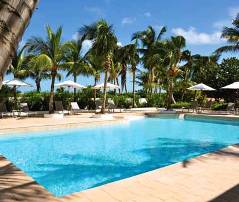
1- Anacaona Boutique Hotel

Anacaona Boutique Hotel, Meads Bay, Anguilla

Meads Bay, Anguilla

On an island where $1,000-a-night rates barely raise an eyebrow, the recently reopened Anacaona Boutique Hotel manages to feel like a splurge. There’s Frette linens and free Wi-Fi in the 27 tropical-chic rooms, two pools—and even waiter service on the beach.

Cost: $250

Don’t Miss: Thursday nights at the hotel’s Fire Fly Restaurant & Bar, when a local troupe performs Afro-Caribbean dances


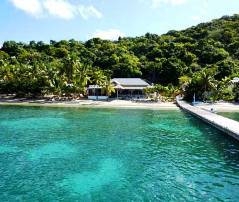
2- Cooper Island Beach Club

Cooper Island Beach Club, British Virgin IslandsBritish Virgin Islands

You won’t find shops, nightclubs, casinos, or even televisions in the rooms at this resort located on Manchioneel Bay on the northwest side of 480-acre Cooper Island. A casual beachside restaurant and bright but simple rooms with kitchenettes, radios, ceiling fans, and private baths with outdoor showers are about all there is here—but that’s enough. Don’t expect much more than palm trees, a sandy beach, clear water, and potent rum drinks.

Cost: $250

Don’t Miss: Many guests say the restaurant is their main reason for coming back—try the local specialty of conch fritters served with a spicy dip.


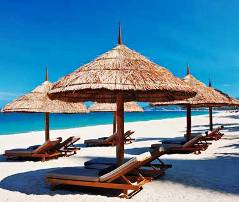
3- Sheraton Nha Trang

Sheraton Nha Trang, Nha Trang, Vietnam

Nha Trang, Vietnam

At first glance, the 284-room Sheraton Nha Trang could be an upscale hotel anywhere in the world. But a closer look reveals local art at every turn and views of island-studded Nha Trang Bay. The hotel’s restaurants cook up a range of cuisines (from street food to European pastries), and you can have snacks delivered to your lounge chair on the palm-dotted, sugar-sand beach.

Cost: $180

Don’t Miss: An on-site cooking class, where you’ll learn how to make beef pho and shrimp rolls.


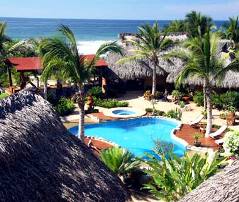
4- Present Moment Retreat

Present Moment Retreat, Troncones, Mexico

Troncones, Mexico

A still-authentic beach town on Mexico’s Pacific coast is hard to come by, but tiny Troncones, about 20 miles north of Ixtapa, fills the bill. At this Zen-inspired retreat, 10 thatched-roof bungalows, each with a white canopy bed, private wooden deck, and meditation garden, surround a pool that overlooks the beach. Wellness is the focus here, from the health-conscious menu and Ashtanga yoga classes to beachside massages and even life-coaching sessions.

Cost: $230
Don’t Miss: A surfing lesson on Saladita Beach, a nearby surfer’s paradise.


5- Anemomilos Apartments

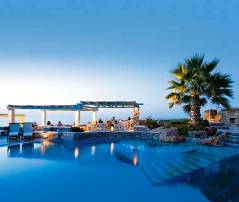
Anemomilos Apartments, Cyclades, GreeceCyclades, Greece

Perched atop the cliffs of Folegandros island, you’ll find the family-run Anemomilos Apartments. Whitewashed walls, private patios, and vistas of the Aegean more than make up for the sparsely decorated rooms. The real draw, however, is the lovely stone-terraced pool and pergola lounge.

Cost: $232

Don’t Miss: A short boat trip from Karavostasis harbor to remote, quiet Katergo Beach.


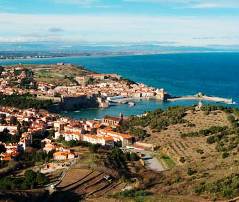
6- Les Caranques

Les Caranques, Collioure, France

Collioure, France

Artists, including Matisse, have long flocked to the colorful fishing port of Collioure for its scenic vistas. And the views are just as enticing as ever, especially from the patio at this hotel, built into a dramatic cliff overlooking the Mediterranean. The 22 light-filled rooms are simply (and patriotically) decorated with white wooden furniture and blue and red accents. Unwind on a rattan chaise longue on one of the small terraces carved out of rock, with winding stairs that lead to small white sand beaches.

Cost: $175

Don’t Miss: A stroll along the town’s Fauvism walking trail to see 20 reproductions of vibrant paintings by Matisse and Derain in the spots where they were first created.


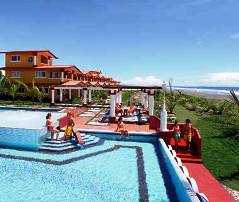
7- Las Olas Beach Resort

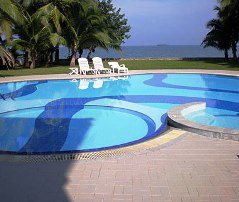
Las Olas Beach Resort, Chiriquí, PanamaChiriquí, Panama

A 50-minute plane ride west of Panama City, Las Olas Beach Resort has 14 miles of volcanic-sand beaches and a mangrove forest. With paintings by local artists and cream tiled floors, all 48 rooms face the Pacific. Board the resort’s 34-footer for some of the world’s best sportfishing, or head to top breaks with the in-house surf pro.
Cost: $78

Don’t Miss: Nearby Coiba National Park’s 355-acre reef.


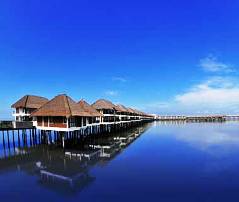
8- Golden Palm Tree Sea Villas & Spa

Golden Palm Tree Sea Villas & Spa, Sepang, MalaysiaSepang, Malaysia

A 90-minute drive south of Kuala Lumpur, the just-opened Golden Palm Tree Sea Villas & Spa pays homage to its name: 392 villas are raised on stilts in eight palm-frond-like rows that stretch out into the Straits of Malacca. The hotel offers a range of activities (morning walks; kayaking trips), but you’ll be just as content by the infinity pool.

Cost: $215

Don’t Miss: A traditional acupressure-focused Malay massage at the hotel’s spa.


9- Dune Hua Hin

Dune Hua Hin, Hua Hin, Thailand

Hua Hin, Thailand

The tiny size of the five-room Dune Hua Hin makes for intimate service, even if its pool and restaurant are on the wee side. That’s a small price to pay for sexy, minimalist rooms right on a coveted stretch of beach along the Gulf of Thailand.

Cost: $127
Don’t Miss: Spotting langurs and macaques at Khao Sam Roi Yot nature reserve, an hour away.


10- Les 3 Chameaux

Les 3 Chameaux, Mirleft, MoroccoMirleft, Morocco

The village of Mirleft, on the southern Atlantic coast, has one of Morocco’s most dramatic beaches. Between the pounding surf you’ll find Les 3 Chameaux, a rustic-chic maison d’hôte with Berber furniture and carpets.

Cost: $112
Don’t Miss: An exfoliating black-soap body treatment in the hammam.

Share/Bookmark

Sunday, February 27, 2011

Should You Pay Off the House?

Family on front porch (Thinkstock)
                                                                                                                                                            
When there was easy money to be made in real estate and stocks, mortgage debt seemed like nothing to fear. Now an increasing number of homeowners are wondering if it makes sense to hasten the day they can say goodbye to a big monthly expense while earning the equivalent of a decent, guaranteed return.

"I'm hearing this question more now that clients aren't feeling as comfortable about the market," says Los Angeles area financial planner Eileen Freiburger.

Maybe you're part of a young family, and whittling down your loan balance seems like a sound strategy. Or maybe you're counting down to retirement (perhaps even already kicking back), have only a few years of payments left, and are wondering if you should just knock off the balance.

But if you're thinking of such a move, you're also well aware that mortgage interest is tax-deductible -- and if history is any guide, putting money into stocks will earn you a higher return over the long haul than putting it into real estate.
The answers to the questions below can help you determine your best course of action.

Do you have more pressing financial needs? 

Anyone who has credit card debt or isn't maxing out her 401(k) should make those the priority. You should also have at least six months' worth of living expenses in cash.
A few years ago you would have been able to pull money out of your home quickly if, say, you lost your job. Now that lenders have tightened up, that's not so easy.

Retirees and near-retirees contemplating a lump-sum payoff need to ensure they have enough liquid savings to handle emergencies such as unexpected medical expenses, especially because it's hard to tap equity on homes without first mortgages.

And you shouldn't pull money out of your IRA to pay off your home loan, since the IRA funds will be taxed at ordinary income rates.

How long do you plan to stay? 

If you plan to trade up to a larger home or downsize to a smaller one within five years, it doesn't make sense to put extra money into your mortgage. The real estate market may be shaky for a while longer, and "you don't want to tie up your cash in your home and then not be able to sell," says La Jolla, Calif., financial planner Christopher Van Slyke.

What do you really gain from the interest tax deduction? 

Assuming you itemize your deductions, you can find out what you save by multiplying the mortgage interest you paid last year by your tax rate (federal plus state). A couple in the 28% tax bracket, with a $200,000 loan at 5%, for example, will save $2,781 in taxes the first year of a loan.
Your tax savings decline the further you get into the loan, as more money is applied toward principal.

For many retirees and near-retirees close to the end of the mortgage, the interest deduction is not a reason to avoid paying off the loan, especially since retirees often end up in a lower tax bracket, says planner Peter Canniff of Nashua, N.H.

How would you otherwise invest the money? 

Put your money into stocks and bonds and you're likely to get a higher return over the long run than you would paying off your home loan, given today's low rates.
If you itemize, you can calculate your effective return by multiplying your mortgage rate and your tax rate, then subtracting the answer from your mortgage rate (you can do this with the mortgage tax-deduction calculator at bankrate.com/calculators.aspx).

So for someone in the 28% tax bracket with a 5% mortgage, the effective rate of return on paying off the mortgage is 3.6%. By comparison, a 50/50 stock/bond portfolio has historically earned 8.2% long term, though it's sensible to expect future returns to be a more modest 6%.
Still, if you're very skittish about the market or are a retiree keeping a big chunk of money in low-earning CDs, you might do better by losing the loan, given that the average five-year CD is paying just 1.6%.
"For retirees, it's hard to beat the guaranteed return," says Anthony Webb, an economist at Boston College's Center for Retirement Research.

Will being debt-free help you sleep better? 

In that case, you might be willing to forgo the extra return you could earn in the market. "Less stress, less worry," says Orlando-area planner Brian Fricke. "Sometimes that matters more than the math."


Share/Bookmark
The best time-saving tips, techniques, and to-do lists for polishing off the kitchen.

Kitchen Cleaning To-Do List
Photo: Frances Janisch

Kitchen Cleaning To-Do List

When cleaning the kitchen always start with the sink. "Keep it empty and shining," says Marla Cilley, author of Sink Reflections (Bantam, $15, amazon.com) and creator of FlyLady.net, a housekeeping website.

A sparkling sink becomes your kitchen's benchmark for hygiene and tidiness, inspiring you to load the dishwasher immediately and keep counters, refrigerator doors, and the stove top spick-and-span, too.

Every Day Kitchen Duties:
• Wipe down the sink after doing the dishes or loading the dishwasher (30 seconds).
• Wipe down the stove top (one minute).
• Wipe down the counters (one minute).
• Sweep, Swiffer, or vacuum the floor (two minutes).

More from RealSimple.com: 
Every Week :
• Mop the floor (five minutes).
• Wipe the cabinets, backsplashes, and appliances (10 minutes).
• Wash the dish rack (four minutes).
• Wipe the switch plates and phone (one minute).
• Wipe the inside of the garbage can (one minute). 
Every Season:
• Empty and scrub down the inside of the refrigerator (30 minutes).
• Empty and clean the insides of the utensil drawers (15 minutes).
• Scrub down the cupboard exteriors (30 minutes).
• Clean the stove-hood filter (10 minutes).
• Perform "Shiny Sink 101". (See Below)

Let It Shine
Photo: Mikkel Vang

Beat the Clock

In the time it takes to brew a pot of coffee, you can get through your "every day" list.

Be Prepared

Keep extra garbage bags (or a whole roll) at the bottom of your trash can and never again have to retrieve an apple core from a bagless bin.

Let It Shine

Streak-free stainless-steel surfaces are the Holy Grail of kitchen cleaning. Caldrea's olive oil–based Stainless Steel Spray promises to reduce fingerprints. (Starting at $12, Yahoo! Shopping)


Shiny Sink 101
Photo: Frances Janisch

Shiny Sink 101

1. Fill sink to the rim with very hot water; add one cup regular bleach. Soak for one hour.
2. Drain and rinse thoroughly.
3. Scrub with Ajax, Bon Ami, or baking soda.
4. Be sure to rinse thoroughly.
5. Shine with Windex or another glass-cleaning spray. Dry thoroughly.


Cleaning Kitchen Odds and Ends
Photo: Mikkel Vang


Cleaning Kitchen Odds and Ends

The quickest way to clean and disinfect these supplies is to put them in the dishwasher.
• Burner grids and knobs
• Brushes and combs
• Toothbrushes
• Plastic utensil organizer
• Refrigerator drawers
• Drain catch
• Sponges
• Dish rack
• Plastic toys (use discretion)


Cleaning Supplies to Keep in the Kitchen
Photo: Mikkel Vang

Cleaning Supplies to Keep in the Kitchen

Clorox Disinfecting Wipes (Starting at $4, Yahoo! Shopping): for all hard, nonwood surfaces. They leave a fresh, nonchemical scent.

Windex Glass and Surface Wipes (Starting at $4.50, Yahoo! Shopping): for windows and chrome.

Microfiber cloths and mops, such as StarFiber ($17 for mops, $3-$11 for cloths; starfibers.com) or Act Natural ($22 for mop, $10.50 for cloth; euronetusa.com: green alternatives to disposable wipes, or to chemical cleaners and paper towels. For cleaning all surfaces. Especially effective for polishing stainless steel.
Bleach.
Ajax ($2.70 drugstore.com), Bon Ami ($4, drugstore.com), or baking soda.

Clorox ReadyMop (Starting at $16 for starter kit, Yahoo! Shopping): Wash the floor without a bucket. Works on most surfaces.

• Broom, Swiffer (Starting at $11 for starter kit, Yahoo! Shopping), or handheld vacuum: for crumb busting.

Share/Bookmark

Meet The Dorky, Controversial Mascots For The 2014 Olympics


A snowboarding leopard, a figure-skating bunny and a polar bear wearing a scarf will be the three mascots for the 2014 Winter Olympics in Russia. Though those are some of the safest choices imaginable, the decision has led to charges of plagiarism, corruptibility and vote-rigging.

The winners were announced on a live television show broadcast throughout the country. Viewers cast over 1 million votes for the nine candidates and officials selected the top-three to serve as Sochi's official mascots. The snow leopard came out on top with 28 percent of the vote.

The announcement was not without some controversy. Ded Morez, the Russian equivalent of Santa Claus, had led in early polling but was pulled from the ballot at the last second when Russian organizers feared that their country's folk hero would become official property of the IOC. That decision left room for the following three winners, which are said to "encapsulate much of Russia's self-image."

Snow leopard

The snow leopard was the favorite of Vladimir Putin's. The Russian prime minister favored the cat because he is "big, strong, fast and beautiful." Not coincidentally, the mascot's popularity rose once Putin threw support its way. Its self-confidence swagger is "not unlike Putin's own projection of machismo" and the fact that the leopard enjoys the prime minister's favored martial arts makes some think the character was based on Putin himself.

Prominent Russian political analyst Dmitry Oreshkin told a Moscow radio station that he believes there may have been some voting irregularities in the telephone voting system that led to the leopard's victory. The insinuation is that Putin wanted the leopard so the leopard somehow made it to the top of the voting. That's silly. A rigged vote in Russia? Preposterous!

Bunny

The bunny will be wear ice skates in a nod to Russia's once-great figure skating program. No word on whether the bunny was in cahoots with the French judge to help with the victory.  

Polar bear


The Associated Press says the final mascot looks "dorky." Whether that's true or not (and it totally is), the creator of Russia's last Olympic mascot says it's plagiarism. Viktor Chizhikov, the man who designed the mascot to the 1980 Summer Olympics in Moscow, believes this bear is a direct copy of his.

"This polar bear, everything is taken from mine, the eyes, nose, mouth, smile," he told a Moscow radio station. "I don't like being robbed."
You be the judge:
Yes, both bears have eyes, noses, mouths and smiles, as do all cartoon bears. There's only so many ways to draw an anthropomorphic cartoon bear. You don't see Winnie the Pooh with snarling fangs, you know?

One is white and has a scarf. The other is brown and wearing an Olympic ring belt buckle. Other than the fact that they're both from the ursus genus, there aren't many similarities. The Sochi mascot may be unoriginal, uninspired and bland, but it's not a copy.

Olympic officials are in a no-win situation when it comes to choosing mascots. If they go for something different, they're ripped for making nonsensical choices that have nothing to do with sports or the host city. If they play it safe, the officials get lambasted for not having any vision.

Mascots exist for merchandising and it's easy to image a child snuggling up with a Sochi polar bear or playing a video game with the snowboarding lion. Sochi's choices aren't groundbreaking but they're not awful and they'll serve the purpose for which they were created. And, best of all, they won't terrify children like these guys

Share/Bookmark